Agile Methodology, Customer Experience, Project Management, Successful Outsourcing
If you search on the Internet for «agile project initiation» you are going to find a LOT of templates. People want structure and easy answers, so of course, these simple answers rise to the top of every search. Many (if not most) of the templates offered are pared-down formats from the Project Management Book of Knowledge (PMBOK) Project Initiation Documents (PID). There is nothing basically wrong with the idea of using templates or most of the templates offered, except – they tend to become prescriptive when they should be taken as guidance.
From the Agile Manifesto: «…we have come to value:
Working software over comprehensive documentation,»
With that in mind, we should ask – why do we document agile projects? Often, the answer is – because it is required (by someone) when in reality the answer should be – to communicate. But again, that simple answer fails to guide us to the necessary outcome:
- Documentation should be a natural part of agile project initiation, but not the goal. It should proceed from on-going discussions between stakeholders, the product owner and the development team that is developed in Sprint 0, but it must not end there. The conversations and the documentation of outcomes must continue through the lifecycle of the project and the product.
-

Initial documentation is just a strawman
Documents gathered from product owners and key stakeholders are starting points, not final documents. Documents developed by a designated team member to fill out a template are strawmen to be examined, discussed, questioned, and used as a base for the ongoing development of understanding within the entire project team.
- Living documentation formats should be preferred over static. In smaller projects, it may not be necessary to manage documentation formally, but in most cases using the same concepts as those used for source code management is a valid guideline. Properly maintained, living documentation answers the questions, «when was this decision made? by whom?» and gives a revision history that tells the story when necessary, but only makes it apparent when needed. It needs to include simple artifacts of these discussions – photographs of whiteboards, screenshots of modified mockups, etc. – in preference to notes developed after the fact and out of the sight of the team.
- During Sprint 0, the aim must be to develop enough trust among the project team members to allow questions and dialog to form the base for a common understanding of those items that are included in most PID templates. If initial documentation is «handed down from on high» to team members without open, trusting discussion – it cannot be internalized by the team and it will not respond to the inevitable changes that will come as discovery and learning continue throughout the project. Agile software development embraces change by allowing the project team to recognize the inconsistencies and discoveries that will come out during development, surface them and deal with their impact through discussion and collaborative negotiation.
And before we get too far away from it – there are some really strong ideas in the Agile Modeling page on Agile/Lean Documentation. Honestly, though, there is a lot of information in that reference that should really be digested as a part of understanding agile, not as a guideline for a new project. For that purpose, this short piece is a better resource. But, if the outcome of project initiation is not a bunch of filled out PID templates that we can all take back to our cubicles and file away – What is it?
Agile Project Initiation is All About Communication
With the ideas we have mentioned in mind, we have to acknowledge that open, trusting, collaborative communication does not happen automatically in an agile project team. There are natural stages that every group will go through before they can have the kind open discussion needed without fearing it will harm relationships and respect. Discussions need to be wider than the project infrastructure, technology, and user stories, without the feeling an individual is stepping over the boundaries by asking about non-functional issues. We might need to know:
- Does the culture and background of key user profiles matter to the software development team?
- Does the role of key subject matter experts (SMEs) in product development for an organization make a difference to who needs to be included in discussions?
- Are we using a Lean Product Development model with the inclusion of stakeholder users as part of Minimum Viable Product (MVP) development?
- If we are working in a DevOps implementation, how does that change our standard production procedures?
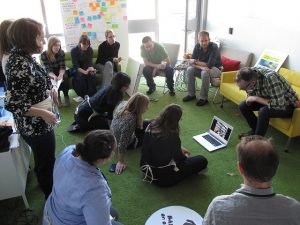
There are all sorts of questions that are not (and cannot be) included in standard PID templates but could be critical to a specific project. If we don’t discuss our viewpoints and ask questions, we run the risk of assuming we have a common understanding and making decisions based on those assumptions. Every project, every team, every organization is different. In the best case, we can open ourselves up to collaborative discussion by getting the team together, face-to-face during project initiation, for dialog and team building using team games and facilitation with a bias to being productive, explorative, and fun. Using these techniques, we can strengthen the bonds and shared risks necessary to maintain a successful project throughout its lifecycle.
 In cases where face-to-face project initiation is not possible (hopefully more rare than the rule), much can be accomplished with video/voice meetings if they are relatively short and like agile documentation, structured just enough to ensure the meetings reach necessary outcomes and allow for continued direct discussions among stakeholders in the team when needed. There is nothing much worse than sitting in a meeting where a long, passionate discussion between two team members seems to be sucking all the air out of the room – and the meeting outcomes are lost.
This piece is relatively short and again, more of a guideline than a prescription for agile project initiation, as it should be if we are to «eat our own dog food.» Bottom line:
- Don’t be afraid to pull out a template when you start your next project, or when you look at it – crumple it up and throw it away so you can start your own list based on what you know and don’t know.
- What you think you know or don’t know are assumptions and should be treated as such both during project initiation and throughout the project. Only a discussion with open questions between team members can validate ideas and give us a basis for moving forward. And the assumption that is understood as valid today may not be completely correct at another time.
- Documentation must be limited to what is necessary when it is necessary and maintained throughout the project as living knowledge. Agile documentation should not be the domain of one person or one role. It must be available and dynamic – allowing everyone on the team to contribute when necessary – in a wiki-style rather than as a bunch of locked Word documents.
- Agile project initiation should focus on both the productive side – bringing together the information needed to organize the project, initialize environments, and the functional user stories needed, as well as the people/team side – developing the understanding, trust, and communication necessary to work collaboratively throughout the project. Ignoring either side is perilous. Assuming the job is done at the end of Sprint 0 is fatal.
Scio is a vendor of agile, nearshore services for software development projects with our customer base in North America. We can provide project-based or dedicated teams as required for each situation. We would be glad to discuss how our broad base of experience and skills could help you be successful with your next project. Contact us for more information.

Customer Experience, Nearshore, Project Management, Successful Outsourcing
As a provider of nearshore successful software development services, Scio has a proprietary interest in assuring the success of our customers’ outsourcing projects. But of course, in that respect, we’re no different than any service provider. So, it could easily be said that this article and more that will follow on this critical subject have a built-in bias we can’t ignore. We want you to understand our experience, our
business model, and how it shapes our approach to providing outsourced services. We hope that understanding will lead you to explore working with us and to hire our team. So yes, this is an exercise in self-interest…. But that said, we also have an interest in promoting improvement in our industry and the knowledge of critical success factors (CSFs) for the outsourcing of software development. This certainly isn’t a new subject – both the buyers and the sellers of outsourcing services have been trading tips, CSFs, and white papers on the subject for years. A quick Google search will turn up thousands of papers from professional societies, trade journals, buyers and suppliers in the field. But it is a sufficiently rich subject, with ongoing learning and improvement, to continue the conversation among participants. Do we have important information to add? We believe we do and we’re willing to expose our knowledge and experience so you can judge for yourself. To begin the discussion, let’s set a few common terms in context:
- Outsourcing is a broad subject and different industries approach it from different angles. In basic terms, we’re only discussing the outsourcing of software development, but many of the lessons learned in outsourcing across other industries do apply. The term comes from tying together the words used to describe «outside resourcing» – bringing resources from outside a company to meet business needs. With that in mind, outsourcing can describe the contract of work to a provider in the same building, city or country, just as well as it can describe the outsourcing of work to a provider in a different country or a different continent.
- Information Technology (IT) Outsourcing is generally considered to be a subsector of Business Process Outsourcing (BPO) that involves operation, management and maintenance of IT services and infrastructure within an organization. Although technical skills are necessary to maintain aspects of IT operations, generall software development is not the primary driver of IT outsourcing contracts.
- Offshore or Offshoring is a term that, like outsourcing, has many meanings specific to the industry where it is used. For our purposes, it means the use of service providers with working hours that have very little or no overlap with their clients. Generally, these providers are on different continents with completely opposite work periods. A great deal of successful software development outsourcing is done by offshore providers so it is not intended to have a negative connotation. But, in many software development projects, communication and collaboration are key and in that respect, using offshore services requires special adaptations that both the client and the provider must be aware of and enforce.
- Nearshore or Nearshoring in our context refers to the contracting of work to providers in a different country that shares significant working hours overlap and often shares a border, region or continent. Scio is a nearshore provider of software development services to North American clients. Our services leverage the benefits of a nearshore relationship with our clients so the situations where we work best tend to exploit those advantages. Successful software development outsourcing relies to a large degree on the relationship between the client and the service provider and the requirements of the work itself. Some software development can leverage nearshore advantages better than others. Some providers have adopted practices that lower the risks inherent in software development outsourcing, regardless of their physical proximity to their client teams. Regardless, understanding the differences between offshoring and nearshoring of software development projects is an important subject for all participants in the industry. There is no «one size fits all» as evidenced by the growth of both nearshore and offshore development centers within large outsourcing consultancies.
- Agile Software Development is a methodology that is widely used across the software development industry. It is based on the idea that software development projects should be composed of short, iterative cycles producing valuable software incrementally while allowing for the evolution of the results based on constant consultation and interaction with the client and user base. The methodology itself is constantly improving and allows for adaptation to many situations. Because of this flexibility, the agile practices adopted for one project or practiced by a development team will vary, but overall the basic principles as they apply to client and team interactions and software quality during a project are expected to remain.
- Scrum Software Development is an extension of the agile framework for software development down to the team level. It includes descriptions of roles, processes, and ceremonies that strengthen agile principles and give structure to the software development process. Like agile, it is an adaptable methodology but it does include more detail specific to the software development process. Scio provides software development teams using a proprietary implementation of agile and scrum. Not all software development projects require agile or scrum, but most can benefit from some level of integration with the methodologies.
- Distributed Agile Teams are a part of the outsourcing of software development when you use either nearshoring or offshoring of a part of your agile team. In agile/scrum methodology, a premium is placed on open and frequent, face-to-face interactions between the development team and the product owner from the client-side. But, agile is also practical and adaptable, so there are practices that help to overcome the team isolation and improve interaction when parts of your team are remote. Scio is a provider of distributed agile teams for software development and integrates the practices necessary to assure success in these situations in all our projects.
What is a Successful Software Development for You?
It is hard to discuss «success» without knowing what it means to clients in general and it is almost impossible for a specific project to be «successful» unless all participants understand what it means from the start. In simple terms, most people would say without thinking it means providing software on time, on or under-estimated costs and that delights users – but that simple definition ignores all the trade-offs and pitfalls that need to be avoided or mitigated and the stakeholders who must be satisfied to arrive at a successful outcome. In researching the literature on this subject, an
IEEE literature review came upon the subject that found some interesting results:
Top 5 CSFs for Success in Software Development Outsourcing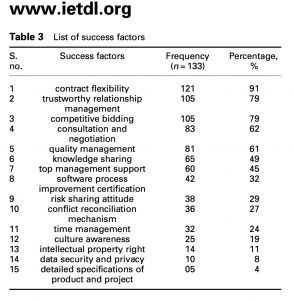
- Contract Flexibility
- Trustworthy Relationship Management
- Competitive Bidding
- Consultation and Negotiation
- Quality Management
Last 5 CSFs for Success in Software Development Outsourcing
- Time Management
- Culture Awareness
- Intellectual Property Rights
- Data Security and Privacy
- Detailed Specification of Product and Project
These results came from a specific set of criteria concerning the basis of the outsourcing contract and relationship, as well as the contract and contract management – rather than a soft assessment of project outcomes, so it is probably not what you might think at first. But consider the elements of the top 5:
- Contract flexibility, like agile practices in software development, this allows the project to evolve in various ways to reach a successful outcome. It is a realization of the simple fact that at the outset of a project, and throughout the development cycle, participants don’t know what they might discover or how they will work together. A flexible contract, instead of locking them into a tight box, provides a framework for realizing opportunities not foreseen at the beginning of a project or dealing with unexpected issues that might derail the project. A good contract focuses on the objectives of the outsourcing relationship rather than operational details.
- Trustworthy relationship management gives everyone involved the ability to bring issues up without fear and mistrust. It allows open negotiation during the development process without bringing everything to a screeching halt. Again, it acknowledges the established truth of software development – there are things we don’t know and opportunities we haven’t considered that will be discovered as we move forward. We won’t be able to consider them if we don’t have a relationship of trust between the players.
- Competitive bidding, when it is done not just on price, but on a range of weighted factors, helps to increase the feeling of trust and control between the service provider and the client. Everyone understands what is important from the outset or has explored the issues until a successful conclusion is reached. Blind bidding, where bids are submitted, but no discussion or negotiation occurs among the top bidders and the potential client do not build this level of understanding however. No amount of paper and diagrams can substitute for the level of understanding that can be reached in direct, verbal negotiation.
- Consultation and negotiation are a realization of the fact that constant communication is necessary in all software development projects to insure the development is on track to meet the goals set out in the beginning of the project or, where needed, the teams can negotiate in good faith to reach alternative outcomes that better fit the situation as it has developed. Virtually all software development projects need both a mechanism to ensure open communication and negotiation.
- Quality management, not just against a set of detailed requirements (that is number 15 in this list after all). When everyone is involved in quality, it becomes a key to reaching a successful outcome. But as the agile methodology guides us, only if the management of quality is a continuous process throughout the incremental software development process. If it can only provide feedback at the end of prescribed phases or the end of the project, the risk of going off-the-rails becomes too large and failure to reach the necessary outcomes of a project area almost assured.
Now, of course, you are likely to see a different list in your head or have a specific list of CSFs in mind for a project. But list brings up an important consideration – what weight should you put on the need to deal with change and to work successfully with your vendor throughout a project or relationship? And it is important to understand, this is a result of the frequency of a CSF being identified among several papers, not the weight it was given in any one paper, if indeed weights were given. So the number of times a CSF was mentioned in the surveyed literature produces the order of the list.
Nearshore? Offshore?

We find these kinds of communication problems come up in many aspects of the provider/client relationship in outsourced software development. Agile and scrum development practices address these problems well, but in the case of offshore services, the agile model becomes stretched in ways that require adaptations that can be costly or distracting in the course of project operations. That is not to say that nearshore distributed teams, a model we use frequently, do not require specialized planning and adaptations, but it is part of our standard practice package, not something we do on a one-off basis. We find all projects benefit from attention to better communication and tighter relationships between our teams and their product owners. And we have that built-in advantage of nearshore; our development team is working in real-time with the client team. There is a lot more to discuss successful software development outsourcing – and we will be doing just that as we continue to provide information from the field.
Agile Methodology, Customer Experience, Nearshore, Product Development, Project Management, Successful Outsourcing
Lean Product Development (or Design), LPD, is gradually becoming a standard methodology in software development in much the same way that agile, scrum and lean have become industry standards. But, as is the case with other «standards» – many people say they have strong implementations, but if your product development team practices LPD principles, you might have trouble trying to integrate their approach. That problem can be troubling if you’ve invested in a rigorous, repeatable process for developing and releasing new software products and then find it difficult to find outsourcing services who understand your goals, your process and can work alongside your team seamlessly.
If you have software applications as a part of your services portfolio or directly to clients and use LPD methodologies, it is important to fully integrate your development team. But, if you are using an outsourcing service, what should you expect? How important is it to integrate your outsourced team?
A Little Level-Setting
In strict thinking, although the term «LPD» is used interchangeably for design and development, there are some differences in focus between the two in implementation. Both are based on Lean, the principles that started with Toyota Manufacturing and have evolved to embrace a process of finding solutions to customer problems that emphasizes iteration, reducing waste, and lowering risk. Broadly, both are informed by the Lean Startup Methodology, but because LPD has been adopted by many large organizations for the development of service and product lines, lessons from Lean Startup are brought down to the product level, rather than at a business model level as they are for startups. And, because we are specifically interested in services, software and software development, rather than manufacturing and the development of physical products, we can include the fact that all LPD implementations favor the use of agile, scrum and kanban as development methodologies.

As you might guess from the use of the word design, Lean Product Design implementations are focused on the design of the product, the user interface (UI) in software development terms and how the user interacts with the application. A process flow for a design implementation includes a growing system of sketches of screens (or modules), wireframes and design standards that evolve and become more specific as software development progresses through iterations.
Lean Product Development implementations tend to focus on the features required to satisfy user needs and product goals. So, while both implementations will use agile user story techniques, design-based implementations will be placed more in the context of the UI and user experience. Development implementations will focus more on groups of features and user goals. In practice, the differences between the two are relatively small and depend more on the full project team and their process than anything. A development team with clients that tend to be more visual, literal and unsure of needs may find it easier to be design-focused. A team with clients working on a business process and users with strong, informed opinions may find it easier to be more development-focused. And certainly, there are many blends of the two ways of thinking.
So, What Does This Mean?
There are many software applications that embody process and principles from a software product management point of view. How will they work for you if you decide to use an outsourced software development partner to help bring your application to market? Is one or the other better for software applications or integrating with software development teams? Are there methodologies or points to emphasize with potential partners as you discuss how their product development approach and experience?
From a high level, if your potential vendor has good product development experience and understands the product development cycle fully, the software you use for product management and the implementation of agile they use within their software development process shouldn’t matter a great deal – because they should be able to be flexible and do what is necessary to integrate the teams. If they are using something out of a book or a seminar that they have actually practiced a few times with a client – and that client wasn’t themselves fully committed to formal product management – it will be a distracting challenge for both teams to work through a methodology implementation while developing your application.
5 Questions for Your Potential Partner
Let’s start with a few questions to discuss. And a word about interviews: Don’t ask yes or no questions when you are investigating how a vendor operates and works with clients. Instead, ask open-ended questions that should be answered with more than a few words (if they actually have experience and formal services around the area they are discussing). If you don’t get what you feel is a strong answer, again, ask some open-ended questions that go down a level in detail.
1. Tell me about how you use agile in projects with clients practicing Lean Product Development?
The question here is not «do you use agile?» You need to know how agile informs their work with companies practicing LPD and what value they believe their implementation brings their customers. They should also include their practices within agile, such as scrum, extreme programming (XP), or kanban. If they don’t go into this level, ask another open-ended question for more detail.
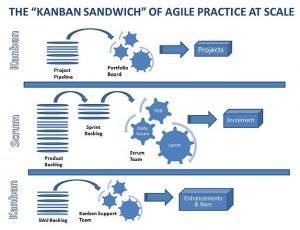
One of the many implementations that large organizations have used.
In most cases, scrum will be the task management and basic development guideline, but it may be extended by XP practices. Some teams will be familiar with kanban and some will mention that they might start with scrum and transition to kanban if the project uses a DevOps implementation aimed at continuous development. At a high-level, the choice between scrum and kanban comes down to a philosophy about work and how to manage tasks. Scrum is generally considered to be more structured, using time-boxed iterations (sprints) and depending on the team to properly estimate tasks for each sprint and with specific planning and retrospective sessions for managing task backlog and priorities. Kanban tends to limit the number of tasks a team can have in work at the same time and new tasks are pulled down into development as soon as a slot opens up in the queue. Kanban is generally more flexible for the insertion of new features and less structured, requiring more feature management to avoid creep before the base application is completed.
It is only a guideline, but most teams find scrum to be a good system in application development and might use kanban or a variation after full release when the application is in maintenance or continuous development. Again, team familiarity and experience in adjusting their «standard» implementation to your team is more important than the particular flavor of the methodology they are using. Process mockups and walkthroughs of feature and feedback flow between the teams is an excellent way to evaluate how things might work and adjust to situations.
2. How do you understand the MVP process in lean product development?
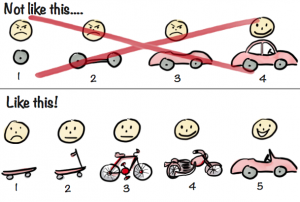
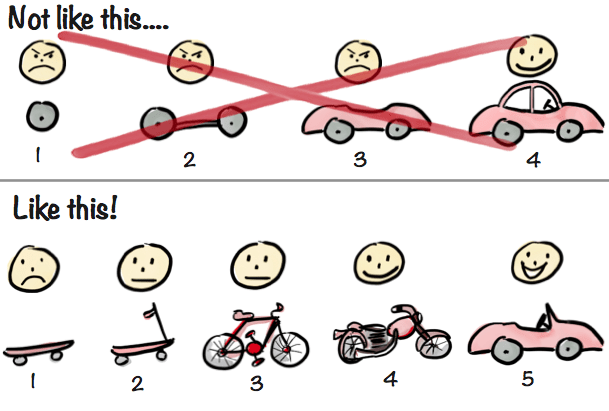
Iterative development of a minimum viable product (MVP) is critical in LPD and probably one of the least understood parts of the cycle by non-practitioners. It is also very hard to estimate effort and time for the development team because it involves an open-ended process with key stakeholders and users. The key issue is to understand what they expect and how they will help you towards viable iterations for validation.
If their understanding is more like the top example in this illustration than the second, it is going to require some real thought to ensure you arrive at validation releases that are fully-formed (loveable) but not feature-rich or too simplistic. This is an element of your work as a whole team where you can really assess the ability of your outsourced team to work fully as a partner in product development. Can they come up with creative ways to give a good representation of the core product to users with less effort and time? Can they see the evolution of ideas and pick out key elements in customer feedback? If you expect or have to micro-manage every iteration yourself, you’re not getting a fully-prepared software development team.
3. How will we capture and manage user feedback during validation and following initial release?
 Now, of course – a developer could just say, «This is your problem, not mine.» To a degree, they would be right, but you are looking for partner-level answers that indicate a willingness to do whatever is needed to make the product development process work properly and to be in position for the long run if your product is likely to benefit from a continuous development/improvement, DevOps-type release. Possible answers can be all over the board from add-on services that support help desk and application feedback to in-app custom modules. At a minimum, developers should be «in the loop» during validation and early release to assure that application bugs are not being reported as feature requests or issues and a system should be available to allow users to see proposed changes and «vote up or down» features they would value.
Including the development team in the feedback loop has a cost, but it avoids a lot of thrash when a feature is not working as expected, allows the developers to be proactive with corrective actions and to understand needs directly from a user’s words, rather than summaries. Again, what you are looking for is not a specific answer but that your partner is willing and able to understand what you need from a product perspective and provide creative solutions.
4. What are our options for capturing user metrics?
This requirement is, of course, very similar to capturing user feedback, so solutions can range from custom reporting within the application to third-party services and application libraries. In this case, the richness of options is key so you can evaluate different aspects of customer acquisition, feature usage, time to complete a process, etc. These features don’t exist in «average» applications, but they can be added relatively easily during development, especially if you compare the effort required to add them at some later point. You will have to get into detail about the kinds of metrics you feel might be most useful for your application and situation, but a strong developer team should be able to give you a range of options for implementation and some sort of dashboard for generating reports.
5. What do you do to assure that quality issues don’t get in the way?
It may seem a bit off point to discuss quality in an LPD focused question set, but the quality is far and away one of the biggest issues when it comes to unexpected project delays. You can’t expect stakeholders and users to be fully engaged in the product development process if planned releases are delayed or major features don’t appear fully formed as promised. A really good application that is unstable or has a poorly designed user interface is a big distraction from the goals of LPD project.
 The best answers to this question include test-driven development, test automation, continuous integration and the tools that could eventually come into play if you choose to go into continuous development. The best case is to make this decision upfront, but things don’t always work out that way. Your primary aim should be to ensure you are in a position to move to that level when you need to without backtracking or having less than full test coverage and to leverage quality assurance tools and processes proactively from the beginning. Your team should be able to focus on feature execution and user experience as they do their acceptance and not buggy code or user interface inconsistencies.
The answers to this question should cover many of the issues of how teams will work and communicate. If they don’t, push follow-up questions in that direction specifically. If you have read anything about outsourcing, you already know that successful agile teams require strong open dialog and collaboration. Don’t let easy answers push you off this point. Understand fully how your project will deal with quality, communication, and ownership of the project goals.
 There are a lot more questions you could ask, but these should get you started. The point is to have a conversation with your prospective vendor and come to an understanding of the methodologies they have utilized, the capabilities they bring to the table, and the customer experience you can expect. A conversation can clear up a lot more issues than a written response to an RFI or a proposal for work and give you a better idea if this is a group you can see your team working with. If you are actually looking for a long term partner and not just a team for a short engagement, it would be wise to have that conversation in person – in your offices or theirs. If it requires some travel, it is just part of the expense of finding a good match. It is much better to have your first face-to-face meetings in a positive, forward-looking atmosphere than when a project is underway and you’ve realized that a lot needs to be done to iron out issues.
Scio is a vendor of outsourced, nearshore software development services to our clients in North America. We provide teams with a background in Lean Product Development as a part of our service portfolio. We use agile methodologies and adapt them to the situation and needs of our clients. If you are interested in how we could partner with your organization to build a great set of new products – Contact Us. We would be glad to take the time to discuss your needs.

Agile Methodology, Customer Experience, DevOps, Nearshore, Product Development, Project Management, Successful Outsourcing
Rotating team members on agile software development teams is a controversial subject. Some leaders in the agile community are strongly opposed to the idea and won’t consider it at any level. Others are open to the subject, but frankly too concerned about the possible downsides to actively plan rotations or even hint to their customers it might be a good idea. And of course, there are the wild-eyed optimists who claim it is the best idea possible for every situation.
Our focus for this article is dedicated teams – teams with members selected for their skills and reliability over the long run. Typically, dedicated teams have no set sunset. They are dedicated to a product or part of a product suite and they generally stay through the active development and maintenance of a product lifecycle – which for enterprise software maybe years. But, that said, the ideas that bring up the subject of rotating members of a dedicated team could apply to any long term project, especially with smaller (3-5 member) teams.
And let’s be honest about one other thing too: the longer the project or product lifecycle, the more likely it is there will be an «unplanned» member rotation. Births, deaths, illness, vacations, career advancements and changes – all sorts of life events have to be managed as a part of maintaining a dedicated team. Even if the time a member is away is relatively short, in less than two weeks, the impact on the productivity of a small team needs to be managed to continue to meet client schedules and expectations. In some cases, the remaining team members can sustain production for a period of time by adding additional hours daily and on weekends, but eventually, that will take a toll on their personal commitment to the team. And when there is an unplanned need to bring in a replacement, there are consequences to the team regardless of the additional manpower provided. In fact, it is well understood that if for some reason two members of a small team needed to be replaced over a short period of time, it would be catastrophic for the team. Bringing the new member «up-to-speed» with mentoring and knowledge transfer takes time and effort of other team members away from their work. And, there is the well-understood impact of a team «forming, storming, norming, and performing» cycles as described by Tuckman. Changing a member of a small team always creates issues. Without some planning and forethought – it can kill the effectiveness of a team for an extended period of time.
So – why would anyone want to consider the idea of rotating team members on dedicated agile teams?
- If unplanned changes in a dedicated team are going to happen anyway, why not be prepared? Why not have the process for selecting, integrating, training and mentoring a new team member planned, documented and tested before it actually happens? Why wouldn’t you want the expectation that «this can happen» and «this is how we deal with it» in place and in front of the team and the client from the beginning?
 The longer a team works on a product, the more likely they are to develop «tunnel-vision.» They see the UI, but they become blind to the problems a new user might encounter trying to use it. They know there are newer technologies that might make something more efficient or resilient, but it takes time to test, advocate change, and demo the option to the client team. If what you have works, is it really worth the effort? The longer a team works together, the more «normal» the little quirks about a product become. In the long run, it can make them resistant to needed change and reluctant to suggest options.
- Working with the same people, on the same product, eventually leads to a level of isolation that can begin to make it difficult to want to get started on the «same old stuff» each day. Developers are part of «geek culture» and love to see new technologies, get input from other sources and try «cool» things. When this happens, production slips and members of the team may become less committed to the success of the product they are working on. It doesn’t happen in a day; it is a slow drip that eventually eats away at the team and makes it less effective. It can also make individuals on the team consider career changes because they are afraid their resume will reflect stagnation rather than stability.
- Bringing in «fresh (but experienced) blood» can bring cross-pollination from other experiences, new points of view on coding practices and processes, a new look at alternatives as you move forward and other benefits from another set of eyes on the project. If long term members of the project are not ready to accept new ideas, they can create strong resistance, but if they are positively primed for the idea by considering they could also benefit individually and as a team, it can be a shot in the arm for the team.
- «Ownership» of a product, or an area of responsibility, can be a strong motivator for a team. Their understanding of its deeper value and continued success is part of their pride and keeps the team on track. But, there is also a downside. If the team is the single point of knowledge and «truth» for a product, they are also the single point of failure. If there is no base of knowledge about the product outside of the team, in the wider pool of developers around them, there is no way to replace a team member easily or help them if there is a problem that causes a loss of a member or if the team runs into a serious internal disagreement (it does happen).
- Operationally, these long-term teams become silos. Outside the team, they are the go-to subject matter experts that always have the answers. Inside the team, individuals tend to become specialists, filling a niche that no one else can come close to. This not only runs against the whole concept of «agile organizations» – it becomes a growing risk within the organization.
There are more reasons too – but those concerns represent some of the more common drivers of the idea. They are all real issues and the problems the teams dealing with them have an impact on the projects they are in. But – does planned rotation actually solve the problems? Does the upside outweigh the downsides? Can rotation be planned well enough to overcome internal team dynamics? Will the supposed benefits last long enough to make rotations something you want to do? Can you actually present a case that would make client support, rather than oppose, the practice?
The answer would have to be – it all depends on implementation.
- Like any change, member rotations have to be sold internally before they can be implemented.
- Frank conversations about the health of teams, experiences in long term engagements have to be surfaced and alternative solutions have to be discussed.
- The timing and requirements for new members have to be considered and accepted by the existing team members. Simply dumping the idea on them without preparation is sure to bring disaster.
- The level of the incoming team member will make a difference in acceptance. Replacing a senior member with another senior developer may be more difficult than bringing in a mid-level or junior developer in their place. With less seniority, the new member will have lower expectations and less to live up to. They will be more accepting during knowledge transfer and mentoring and give existing team members new opportunities to grow. But if the outgoing member is considered to be a team leader, the impact may be very deep no matter who is brought in.
- If the practice is fairly new within the organization, replacing a team member is likely to be more problematic regardless of planning and thought. The practice can be new institutionally or within the team, it really doesn’t matter. If team members are not experienced with the concept, issues will arise. Assuming the issue will iron themselves out eventually is not a good way to manage change.
- Frequency is important. Single-member rotation will always cause thrash and lost productivity no matter how well it is planned. A team can only sustain so much change without becoming distracted and losing their center. In complex environments, it may take a considerable time for a new member to build up the necessary knowledge base. Most industry experience seems to circle around a period between six and nine months for the change of one member. More than that and the team might never gain cohesion again. Less than that and silos will begin to form. But, there is no perfect point. You can’t change a member during a critical release for a product, no matter what the calendar says. You have to work with the client team to gain acceptance and cooperation. Timing is a hard nut to crack and will be different in every situation.
This is an important and evolving area of management for outsourced agile teams. It is not widely discussed in the software development industry. Clients come to outsourcing vendors to avoid issues like team cohesion, resilience, and long-term stability. It may be difficult to bring them into a conversation about an issue that is seen as a vendor responsibility.
But, there are some ideas that are coming forward and worth considering. Larger outsourcing vendors can propose a dedicated «pool» rather than a team. The actual team in production continues to be a small number, but the vendor commits to a larger group, perhaps 7-10 including the active team, of developers that are involved and can become a team member with less overhead from change. This allows the members of the pool to become involved in project and product discussions, review code, and be the sounding board for ideas. There has to be an adjustment of the cost to allow this kind of an arrangement and a clear commitment by the vendor to avoiding the issues that are considered part of dedicated team contracts, but in certain situations, it is worth considering.
In the final analysis, it is hard to value the practice of rotating team members on dedicated teams. It can seem like a great idea if you have experienced the downsides of long-term engagements where unplanned changes and team stagnation become barriers to success. If the motivation, implementation, and outcomes are not carefully considered and monitored, it can become a serious distraction from productive development. Neither outcome is good so this is an important consideration and the decisions are likely to be different in every situation.
If you have experience with team member rotation (and not just fears or wild optimism) – I would be interested to hear your thoughts. This is still an unsettled area in agile team dynamics.
Scio is a provider of outsourced, dedicated and project teams for agile software development to our nearshore clients in North America. We have experience with many team and project configurations and would love to discuss how we could help with your next project. Please contact us with your questions.

Agile Methodology, Customer Experience, Nearshore, Product Development, Project Management, Successful Outsourcing
Work is always measured in some way. If you are doing repetitive work, the tendency is to measure the number of repetitions, like the pounds of fruit picked by a field worker in an hour or a day. If you are doing knowledge work, the tendency is to simply measure hours of work spent on the problem, assuming that a) the person doing the work has the necessary set of skills and a comprehensive knowledge base of the subject at hand and b) they spent enough time to evaluate the problem sufficiently and provide a balanced solution. If you are doing time and/or payment-dependent contract work, the main consideration is did you complete the work assigned in the contracted period and at the specified cost?
This all seems relatively benign and normal in the world of work because it assigns a value to work that can then be measured and evaluated in various ways. Did you pick more fruit this week than last? Did you solve more problems in this quarter? Did you complete all your contracted work on time and budget?
Software development is, of course, one of the most valuable types of knowledge work being done globally today. Since development is usually the domain of teams and is at this time, largely done with some form of agile and/or lean methodologies, the measurements tend to be a combination of individual and team metrics applied by various means. Some common metrics are:
When we get beyond these three common methods and their minor variations, we start getting into more complex models (!!) that tie team performance, quality, project length, man-hours, adherence to production and methodology standards and complex team models in DevOps implementations.
We Have Questions
At the end of the exercise, however, it is done, we end up with some sort of measurement of the work of software development. But as we do, we need to ask ourselves a few important questions:
 What does our measurement tell us? What is it not telling us? If we are measuring lines of code or functions, is the measurement telling us if the work was efficient or just an output meant to produce more (or a given number of) lines/functions over a given period? Were the lines of code or functions really efficient and useful? Programming is very comparable to writing. Some writers are more efficient at expressing thought and others see a more elegant way to express a thought without addressing it directly. Some programmers are more efficient because they reuse code multiple times throughout the source with efficient use of variables. Some functions in a program are critical and getting them right is tough, requiring time and effort. Other functions are simply «eye-wash» and don’t have a real bottom-line value. There as many ways to game the system as there are ways to produce better code with fewer lines. Every programmer, every team, and every project has different dynamics depending on the language being used, the type of environment, the technical problem being dealt with and many other factors. If you use a pure «number of X metric,» you have to be clear about what it means and doesn’t address.
- Is our measurement comparable? Can it be used over the long term or compared across projects or teams? Frequently, this is where the complex math becomes part of the equation and frankly, begins to fail to do its job effectively. The more we try to «normalize» measurements across a single project, between teams, and across projects and teams, the more subjective the outcome becomes. Were the technical hurdles encountered at the beginning of Project A really comparable to Project B? If we decide there is a significant difference, how do we adjust for it? Did Team A experience more changes in team composition than Team B? How do we account for that issue? Are we comparing skill levels, experience, time to reach «normal productivity» or some other factor? Was Team A really suited to provide the skills and experience needed for the given project? Did their productivity fail to reach the levels expected because of issues outside of their control? In most cases, the more you try to normalize between measures of productivity between individuals, teams, and projects, the less sure you can be you have a reasonable common measure. And in the end, the question becomes, is a comparable metric what we really need?
 Isn’t any measurement better than no measurement? Can we afford to fly blind? Certainly, if you have an outsourced team, multiple teams, and/or multiple projects you have to begin to understand why some projects seem to work well and some don’t. You need to be able to judge if a project is going off the tracks so you can get it back in line before the problem becomes critical. Finding ways to measure performance and productivity would seem to be the best tool to address the common issues in software development projects. But if the measurements we are using aren’t really addressing the problems we have, how are they helping us? Are they really more than just busy work for managers and bean counters?
The more we look at the problem, the more we begin to understand that measurement for the sake of monitoring «something» isn’t really useful. But on the other hand, measuring any aspect of software development is better than monitoring nothing at all and simply hoping everything will work out in the end. Even a weak measurement provides some level of confidence if it is used consistently and we understand its shortcomings well enough.
In agile teams, there is another, more important way to look at things. If we give the team simple methods they agree on and understand, like story points and burn down charts, they will know when they are performing well and when they are pushing too large a boulder up a hill. Inside the team, they know who is consistently performing and producing efficient code with fewer problems. The team knows when its backlog is too great to finish in the allotted time. Team members learn quickly who can be asked for pointers on how to approach a problem properly and who cannot be depended on reliably. We can stand around, pointing out issues with the common ways to measure agile team performance, but their value is those common agile methods are basically useful to the team to understand where they stand in relation to the work ahead of them and their quality performance. Where we get into trouble is when we try to extract the common measures and try to draw larger conclusions from them.
The Reality is – Communication is the Key
If we get past trying to use performance metrics outside of a single project and narrow our focus to what they do for a team inside of a project, we begin to see their value more clearly. The team knows what is going on. They may attempt to fool themselves or others, but in the end, they can see the light in the tunnel and they know if it is a successful end to the project or an approaching train. The problem is to get them to trust each other and the larger team enough to surface the problems they see as soon as they see them, without fear.
The level of trust and responsibility required for open communication and collaboration is perhaps the largest problem faced in software development projects. It is the «why» behind the invention and popularity of the agile and lean methodologies in wide use today. Conversely, the larger the organization, the more critical and costly the project is to the organization, the less likely it is that the team will feel and be enabled to inquire and speak out about the problems they believe they are facing. In a large organization, metrics are the shorthand to avoid having «high touch» with every team and individual. In a costly, critical project, metrics are meant to be the «truth-tellers» to assure stakeholders that things are well controlled, even though everyone knows that metrics can be gamed without much problem. And the more the metrics are relied on, instead of the knowledge inside of the team, the more likely it is the project will get out of hand before the problems are addressed.
Responsibility. Trust. Communication.
So what is the bottom line on measuring performance and productivity in software development projects?
- Measurement is most useful inside the software development team itself,

Planning Poker
where the knowledge resides about what is really going on from day today. Everywhere else, it is just as likely to be smoke and mirrors as it is, to be honest, and useful – depending on who is using the metrics and for what purpose. If the team doesn’t understand the metrics applied and can’t use them to better understand where they are in relation to the work to be done, their quality performance and general efficiency as a team, the metrics will fail to give back their primary value – keeping the team and project on track.
-
The agile methodology relies on individual and team responsibility, trust and communication. If these three points cannot be achieved within a team, agile and scrum are just a bunch of processes and procedures that may or may not be helpful in organizing work. If the team is just «going through the motions» in taking responsibility for tasks, assessing and managing their backlog, and participating in standups and retrospectives, additional metrics and measurement will not provide much value. They will provide information to a larger audience too late to enable outside forces to do more than triage injuries to the project.
- Working through what may appear to be problems or what may seem to be a simple solution requires peer-level coaching and communication, not blame. If we understand that the team itself really knows what is going on – getting them to assess the problem honestly and figure out how to address it requires something other than pointing fingers, avoiding issues and top-down communication. It also means that the team needs to take responsibility, as soon as anyone recognizes a problem could be on the horizon, to consider it seriously and determine both the size of the problem and solutions that could be used to address it. And so what if the team raises an issue that may turn out to be nothing of great importance? We’ve been called to action to look at it and we will all come out of the conversation wiser. If everyone in the conversation addresses each other as a peer, rather than hierarchically, there is a good reason to think that the next time a problem is encountered or perceived, it will be openly addressed, rather than swept under the rug.
Three points to consider and use in conjunction with standard agile and scrum-based tools. You can use more and you can draw all sorts of conclusions from the systems you bring together. But in the end, if they don’t bring immediate value back to a current project, what value are they really serving?
Looking for a development team? Contact us we can help you!
Scio provides nearshore software development services for our client base in North America. We work closely with our clients to ensure that the projects we are involved in have the level of communication and understanding needed to reach successful outcomes. If you have a project where you think we could help, please contact us. We would be happy to discuss your needs.

 In cases where face-to-face project initiation is not possible (hopefully more rare than the rule), much can be accomplished with video/voice meetings if they are relatively short and like agile documentation, structured just enough to ensure the meetings reach necessary outcomes and allow for continued direct discussions among stakeholders in the team when needed. There is nothing much worse than sitting in a meeting where a long, passionate discussion between two team members seems to be sucking all the air out of the room – and the meeting outcomes are lost.