Nearshore, Remote Work
Productivity is among the top-of-mind issues many companies getting into remote work are considering, and there’s a lot of information out there about its benefits and its drawbacks. So we looked closely at some of the myths about remote productivity and found very interesting stuff to discuss. Enjoy!
By Scio Team
It’s very clear now that our way of looking at work has changed, and the future of this relationship is just starting to be clear now. One could argue that remote work was an inevitability, the natural next step in many industries (technology and software especially) that don’t really require people to be on-site to collaborate and work together well.
However, as we’ve been discussing through interviews with Scio’s Founder and CEO Luis Aburto, and Senior Project Manager Jesús Magaña, there are a lot of moving parts involved in a successful remote work model, and one of the big questions when this trend picked up steam in 2020 was “would productivity remain the same?”
The answer was yes, and it even increased in many cases, but why? What are the mechanisms behind good productivity when working remotely or from home, what myths and facts get involved with the new normal way to work, and how can we harness its advantages for a modern organization?
Myth #1: Productivity is the only measure of success.
Truth:
One of the most interesting insights we got from our interview with Luis was that “the health of a team cannot be measured only in productivity terms”, referring to their emotional well-being and offering the appropriate support, watching out for signs of burnout, and he’s far from the only one to realize this.
Last year, Microsoft published a list of seven trends of remote work, and among them was the insight that “high productivity is masking an exhausted workforce”, which is important to understand why remote work is taking such a foothold, even beyond the pandemic. Workers today are finding out many advantages when working from their homes, and companies are seeing benefits allowing flexibility, because it generally results in a better life balance, and thus mental health.
Now, of course, productivity is important for any industry, and a software company needs to keep a close eye on the team’s progress to make sure a project is hitting its deadlines, but sometimes those requirements have an unrelated cost that can be alleviated with more freedom in the way we chose to work.
A hybrid model, where a collaborator only goes to the office a couple of days a week, or when they need the space for whatever reason (like meeting with clients or having Internet problems at home) works best, as it offers a way to keep up with the organization, while also leaving elbow room to attend your personal life.
Myth #2: Productivity happens continuously for everyone.
Fact:
Around 75% of workers polled by Microsoft mentioned that flexibility in their work hours is one of the top things they are looking for in a new job, and that tracks with the upcoming “Gen Z” entering the workforce during a pandemic.
The explanation behind that is simple: for many people, focus and productivity happen in bursts, and they do not always synchronize with the traditional 9:00 to 5:00, five days a week work schedule. Working remotely gives options, and letting the collaborator choose what suits them best allows for a better application of skills and effort, which is in the best interest of any organization.
Companies like Twitter, which implemented a permanent remote model, or Microsoft, which is experimenting with plenty of options (like working at the office until 3:00 pm to avoid rush hour in traffic), are seeing the benefits of this philosophy, and letting a collaborator adapt according to their bursts and stretches of productivity lends well to an industry that needs creativity and focus as often as software development.
This goes back to achieving a better balance in daily life. Having the ability to adjust to the day depending on the type and volume of work to be done. Do you need to collaborate with others or just get in and get some detailed coding work done? Having more than one check-in/check-out time (like we enjoy at Scio), can make a difference to an individual’s productivity.
Myth #3: Productivity depends entirely on the person.
Fact:
A big negative side-effect of moving away from in-person work at the office was the infrastructure needed to keep productivity moving along. From security measures to VPNs, and other reliable ways to connect to a company’s servers and have all the information you need at your disposal, it certainly resulted in slowdowns while many offices adjusted.
Companies like Scio, which are no strangers to these set-ups and have a lot of experience knowing what works and what doesn’t, know very well the value of selecting the right tools to keep everyone moving forward. In the case of a Nearshore company, for example, it also helps to build teams capable of adapting to the processes of the clients, so you have plenty of experience collaborating in all manners of ecosystems without issue.
What all this means is that there’s an incentive for the Management and IT departments of the world to be selective and careful about the tools they adopt for remote collaborators, which need to be comprehensive and reliable, but without interfering with the work itself.
Easily understandable CRMs that you can teach to someone over a Zoom call, ready access to databases and important files, effective training programs, clear and concise guidelines about Internet activity and cybersecurity, or applications that don’t impact productivity (or at least can be taken into account during a project) are a delicate balance to hit as more and more people choose to work off-site, but well thought off guarantees a successful adoption of remote work.
The Takeaways:
- Today, new employees and collaborators will prioritize flexibility, and that trend is only going up, so it’s best to start adapting ways to offer it.
- Flexibility results in better productivity, as it gives people the chance to work at their best productivity times.
- Choosing the right collaboration tools that doesn’t hinder productivity is going to increase in priority to maintain productivity and minimizing the impact of any measure implemented in an organization.
- As of now, a hybrid model is proving to work best, giving plenty of options to keep a cohesive team that also respects personal time.
Nearshore, Scio
Working with a team is always a challenge, and doing it from another country is a craft. So we sat down with Jesús Magaña, one of our experienced Project Managers to talk about remote work, teaming-up, and the best parts of doing home office. Enjoy!
What does “collaboration” mean for me? Well, since school, teamwork gets a bad rep, as it mostly means dividing homework between several people. A student writes an introduction, another one does the illustrations, another puts everything together and someone prints it at the end, right?
Okay, what does a Project Manager do? I coordinate teams of people every day, so we can reach the agreed milestones of any project at every step of development until we complete it.
There are lots of issues that need to be solved during a successful development cycle, that go from personal problems to more technical issues, like faulty connections, server troubles, to limitations I try to mitigate. You know, the usual “Ah, I can’t get this thing right”, or “We are missing this thing to move on”.
It’s said that a PM manages time, budget, and scope. In reality, I manage people, which requires the usual soft skills. How do you tell a client that something has to be delayed without harming the relationship? How do you bring an issue to the team and correct it? What words do you use to give feedback?
This already has lots of nuance in a normal job environment, where certain situations are more easily approachable when you have a team physically there with you, like going to someone’s desk to check a task’s progress, knowing who is present by looking at their seats, or being available for the team when a problem arises. “Hey, I want to show you this real quick”, or “Can I get your opinion on this”.
For a Nearshore development company like Scio, with collaborators all over Latin America, these situations are different. Bonding and communication have to be considered differently, traded for some advantages that not every company has.
After all, it opens a ton of possibilities in terms of the kind of talent you can work with, be it from your city or an entirely different country. I would have second thoughts about moving elsewhere to work, and the option to join remotely allows us to meet talented people with affinities to everything relating to software, which is great for the overall talent we have at Scio.
Also, more and more clients are trusting the capabilities of Nearshore development, as this industry is particularly capable of incorporating remote models of work, and needing everyone in the same office is increasingly unnecessary.
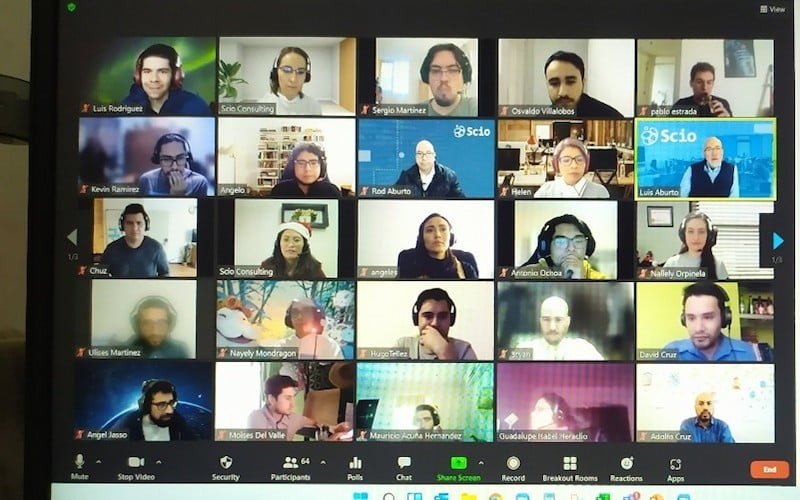
Now, as you can imagine, I spend most of my time on calls and videoconferences. When the pandemic started and we had to move to our homes, it was somewhat uncomfortable. “Oh, they are going to see my house”, or my wife or children would pass behind me inadvertently, but you learn to deal with that.
I know being on camera can be awkward. Maybe it’s just me, but seeing myself on the screen is distracting, as I wonder how everyone else looks at me. I turn that off and try to avoid it, although watching everybody during a meeting forges a sense of teamwork.
Using these tools well is important. In the apprenticeships here at Scio, for example, new developers get training and experience, and doing it online can be difficult. They see someone explaining something on a screen, just like online classes, and there is no sense of a difference between a school setting and a professional one.
The challenge, then, is communicating Scio’s culture to everyone joining us. Is necessary to develop a sense of camaraderie, even remotely, and something that worked for us is having leisure sessions where everyone, even project leaders, can mingle and play something together. We don’t talk about work during these sessions, the point is forming a relationship beyond that, creating the bonds we need to work well together.
Collaborating is understanding that, even if we have different roles, our goals are shared, with an attitude of “Well, I finished my tasks, and it’s only Wednesday. The sprint finishes on Friday, let me see if someone needs help”.
In soccer terms, if a striker scores three goals, he has achieved something great individually. But if the team gets scored against four times and loses, that was pointless.
Collaboration is seeing yourself as part of something bigger you help to accomplish, regardless of your personal objectives.
And you have to keep in mind collaboration with clients directly, the other side of the coin in Nearshore development. Every client has a different approach to every project; sometimes they join during every scrum each week, and sometimes they have more of a “Nice job, see ya’ll in a month for the demo!” attitude.
I prefer a close client; I can create certain transparency where they can see how your team functions with an inside look into the kitchen, so to speak, to see what we are putting on the pizza they want, asking questions, and requesting some changes.
At Scio, transparency is key. Scrum helps, giving the current status of the project to everyone involved, not only the leads. “I’m working in so and so, that’s going well, but this other thing has these issues”, and that helps us to not see each other as individual pieces, but as a unit building something together.
I like the way we are working together now. The team is more productive, and although I miss the old office dynamics, remote work opens tons of connections and made a lot of changes in my personal life.
Do you want to know something cool about working from home? I have lunch with my kids every day. I used to eat out of Tupperware at the office, but now it’s a break when I can spend more time with them.
You see, when your job is transmitting the culture of Scio to everyone collaborating here, dealing with people in a professional, empathic, and understanding way from home, your kids can see it too, and are probably learning something very valuable in the process.
Developing soft skills in other people is part of my job. For example, the responsibility of the developer is to give estimates of the time a task is going to take, and for a junior dev, these estimates are more of a personal wish than realistic plans. So, as PM, I might have a better understanding of the work involved, and I need to communicate that in a respectful and empathic way.
In other words, being a Project Manager today is different. You need to create an effective working environment, make a team self-directed without someone checking every step, while forging a strong relationship with a client with enough transparency they can see results every week.
Taking my soccer analogy back, to be an effective Technical Director you have to know the game, playing matches in every position possible. I’ve been a Developer, QA, analyst, and more, and having those perspectives are crucial to understanding everyone on the team.
In-office or remotely, the point is motivating the team to give their best, solving anything that gets in the way of achieving a successful project. Is transforming teamwork from a chore into the best possible way to work.
Entrepreneurship, Nearshore, Outsourced Engineering Team, Project Management, Successful Outsourcing
By Scio
The importance of soft skills in the workplace cannot be overstated, and doubly so for remote work, when coordinating a team you may not know in person is the core of a successful project. But how to apply those skills?
It’s no secret that managing an effective team requires a special kind of talent, one able to bring the best of every individual in the team, while also keeping everyone on the same page, looking at the same goals. In the old days, you could achieve it by having close proximity with your collaborators, keeping an eye on their needs and difficulties, and doing your best to lessen them to create an effective working environment.
But yeah, that was when the office environment was a given, and managing was a face-to-face affair. However, in the New Normal, where remote work is becoming commonplace, probably with coworkers living in entirely different continents, the skill set necessary to complete a well-done project is changing.
How do you communicate an effective company culture remotely? What do you need to manage talent through a screen? Here at Scio, where working remotely has been the norm since the very beginning (both with clients and collaborators), we know how important these skills are, and how they will become more sought after as this organization model becomes more commonplace.
1. Communicating through a Zoom call: More difficult than you think!
Hey, raise your hand if this situation is a tiny bit familiar to you:
Trying to make a joke on zoom – YouTube
Yeah. As we all know very well, conducting a videoconference is tough, as reading your coworker’s body language, emotions and predispositions are nearly impossible at a distance. Humans are social creatures, designed to pick up on gestures and the tiniest social cues while talking, and doing so through the barrier of a Zoom call is an important skill to attain.
That’s why implementing clear communication rules, and enforcing them effectively is so important. Simple etiquette rules (like turning the mic off when not speaking, giving space to questions and answers, or RVSP any invitation), assigning a person the specific task of conducting the call, as well as being clear if the call is more formal (i.e. presentations with clients) or informal (like a brainstorming session) can make a world of difference in the way a team functions.
Once your collaborators internalize these rules, further strategies will be easier to implement, and you will avoid awkward scenarios like that one.
2. The importance of choosing the right tools
“An artisan is as good as his tools”, the shared wisdom says. And that’s true whether you are talking about making a vase or developing a software app; selecting your tools well is just as important as the technical knowledge applied behind.
Zoom is a good example of the pros and cons of these tools. There are plenty of reasons why Zoom became the choice to work remotely during the pandemic (it’s friendly to use and offers a good range of basic options), but that doesn’t mean this software lacks drawbacks (like its lax security) you need to take into account.
The same is true for any tool you have at your disposal to manage teams and projects, and learning to choose and use them effectively is a valuable ability in any remote team. There are plenty of options to try and decide, but also don’t be afraid to discard anything that is not helping the team to reach their objectives.
Here at Scio, for example, beyond the usual suspects (Microsoft Teams, Zoom, Trello, etc.) we developed some internal tools, like an internal guide with the names and positions of everyone in the company, or a proprietary clocking-in page, that we continually improve and tailor to fill the needs of our clients and developers, making sure all of our developers and collaborators have any piece of information they might need.
3. Remote company culture is possible
As we mentioned, certain skills are needed to do remote work well, and these will grow in importance as more projects realize the potential of Nearshore development. The importance of soft skills has grown in recent times, as being able to communicate with your team is just as important as the technical talent you have behind. So what do you need?
- Have clear expectations: For anyone joining an organization remotely, knowing exactly what’s required of them helps build boundaries and focus efforts on things that matter. Lay them out at the beginning, and should have no problems making everyone work towards the same goal.
- Create working structures: For remote teams, lack of structure on a given day can be an obstacle to productivity. That’s why good team leaders establish a clear schedule of deadlines and meetings and explain in certain terms where a particular collaborator fits into the workflow.
- Determine delivery: In a traditional office, the time in front of the computer seemed to be just as important as the work being delivered, which of course is unsustainable in a remote environment. This is why an effective manager keeps track of the actual output every review (let’s say, once a week), to determine the effectiveness of the collaborator, who can set their rhythm with flexibility. As long as the project delivers by the agreed deadline, everything else becomes unnecessary.
- Encourage social interactions: The best teams have chemistry and rapport behind their collaboration, and managing that remotely is truly a challenge. That’s why social interactions are important; celebrating important holidays, giving them channels to communicate freely, and organizing activities for fun help a lot and creates familiarity between co-workers that otherwise will never happen.
- Give ongoing feedback: Good feedback is the lifeblood of any team, and for remote teams, doubly so. Being gentle with it, but also effective and certain, is an important skill for everyone on a team (not only leaders), and learning how to give and receive feedback is critical to delivering better and better projects.
4. The Key Takeaways
So, what does this all mean? That the best remote teams are those with strong structural support behind that lets their talent be used to its maximum potential. So we can have these few takeaways of the soft skills behind an effective remote working environment
- Pure technical knowledge can only get you so far. Managing with a wide range of skills helps everyone feel part of a team in order to achieve objectives.
- Remote working needs certain flexibility to function, but firm boundaries keep the team focused and productive, from a simple call to delivering a whole project.
- A good company culture needs to be clear and well communicated, and implementing it effectively means the difference between a good team and a so-so one.
This is clear for us in Scio, as our Nearshore model is designed to use these methods to their fullest, and guarantee that any project you have in mind has the right team for you.